
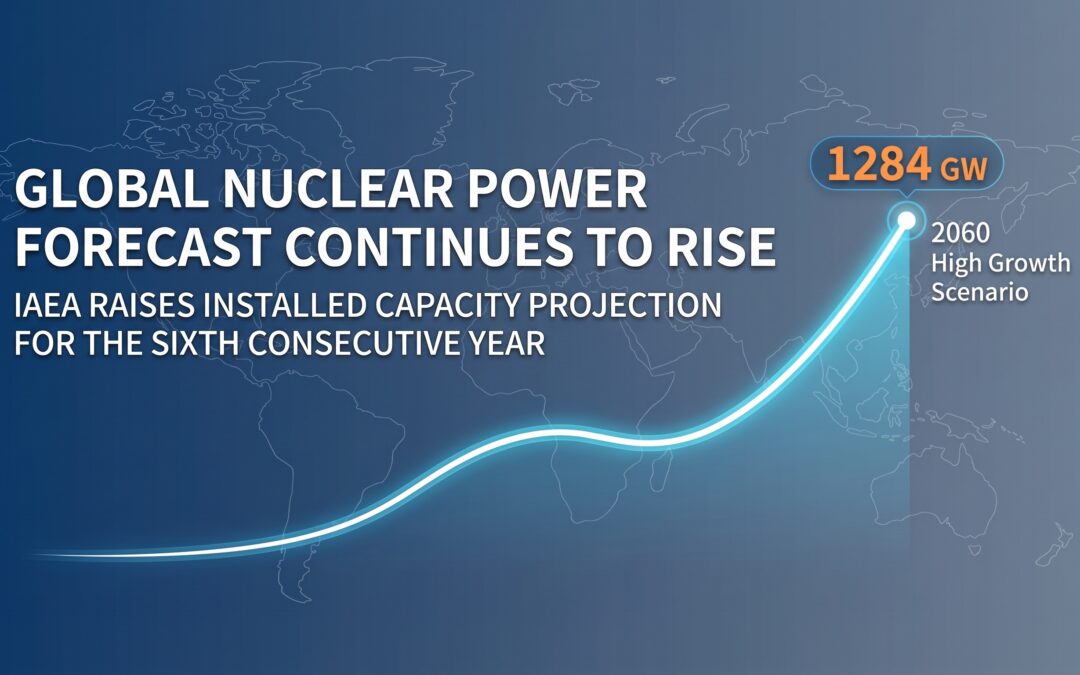
At its 70th General Conference in Vienna on September 14, 2026, the International Atomic Energy Agency (IAEA) released its latest global nuclear power outlook.
This marks the sixth consecutive year the agency has revised its nuclear capacity forecast upward — and this year's report includes a new development: for the first time, the projection horizon has been extended from 2050 to 2060.
Two Scenarios: Nearly Doubling, or More Than Tripling
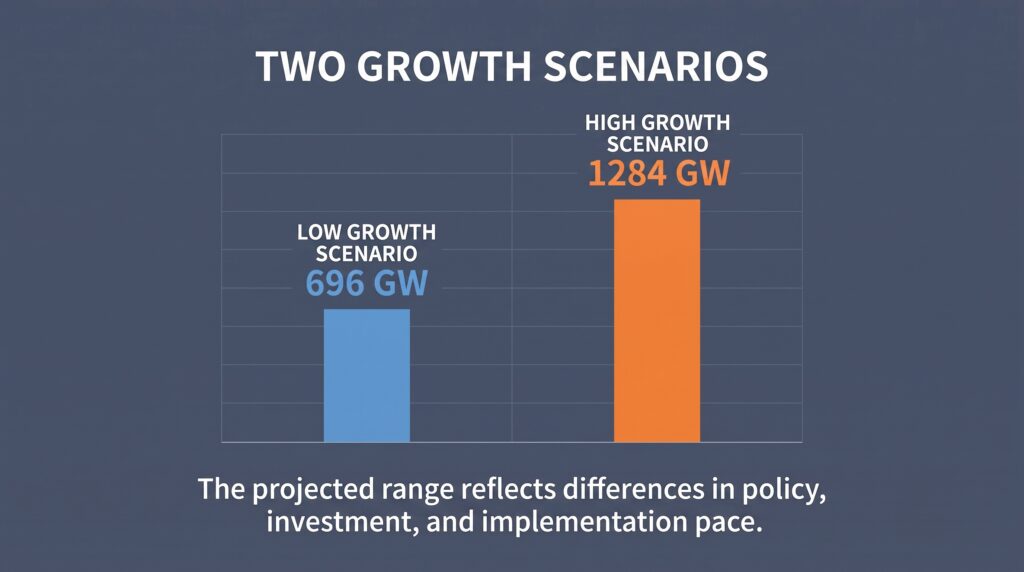
According to the IAEA's latest figures, as of the end of 2025 there were 413 operable nuclear power reactors worldwide, with total installed capacity of 377.1 GW.
The report maintains its low- and high-case scenario framework:
- Low-case scenario: capacity reaches 696 GW by 2060 — nearly double the 2025 figure;
- High-case scenario: capacity reaches an upper limit of 1,284 GW by 2060 — 3.4 times the end-2025 level.
Term note | Gigawatt (GW): a common unit of electrical power. 1 GW equals 1 million kilowatts (1,000 MW).
The IAEA also identified Central and Eastern Asia as the core source of future nuclear growth. Under the high-case scenario, capacity in this region is projected to surge from 114 GW in 2025 to 407 GW by 2060.
Why the Upward Revision — Again?
IAEA Director General Rafael Grossi told the conference that a growing number of countries now view nuclear power as a solution to rising electricity demand and energy security concerns. He singled out two previously underappreciated sources of demand:
- AI data centers: the rapid expansion of computing infrastructure is driving high, round-the-clock, inflexible electricity demand;
- Shipping decarbonization: the maritime sector, which carries roughly 80% of global trade, is increasingly exploring nuclear power to meet propulsion and emissions-reduction needs.
What It Would Take to Reach the High-Case Scenario
The IAEA also outlined several conditions necessary for the high-growth path to materialize:
- New nuclear projects require stable, long-term capital investment mechanisms;
- Industry supply chains and the skilled workforce need to expand in parallel;
- Cross-border regulatory cooperation and global standards harmonization will directly affect project approval timelines and commissioning schedules.
SMRs Emerge as a Key Growth Driver: Expected Penetration Rises Sharply
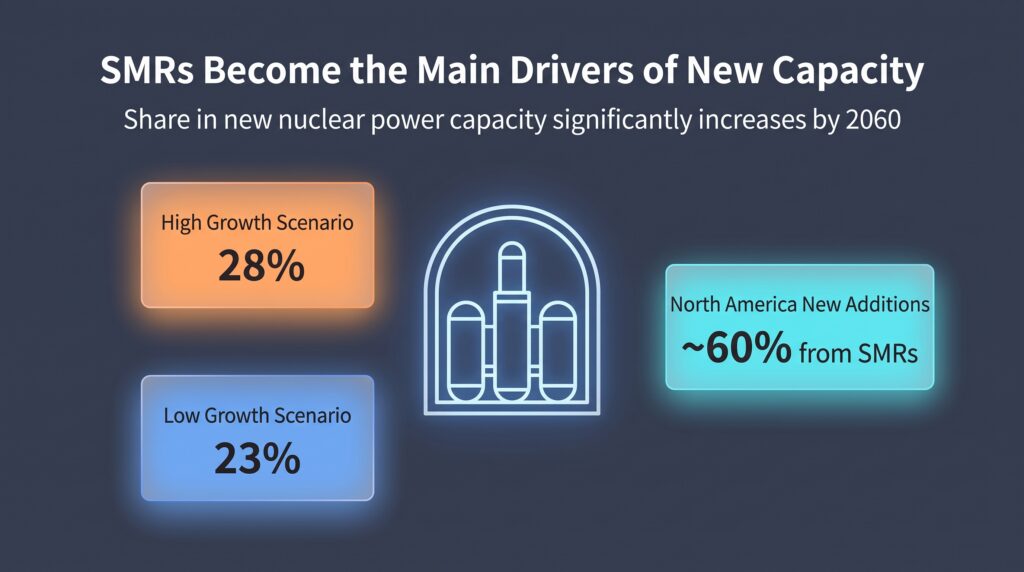
The commercial outlook for small modular reactors (SMRs) is one of the most significant data shifts in this year's report.
The report projects that SMRs will account for 28% of all new nuclear capacity added before 2060 under the high-case scenario, and 23% under the low-case scenario — up sharply from last year's figures of 24% (high) and just 5% (low).
Regional deployment patterns vary notably:
- North America: SMRs are projected to account for roughly 60% of new nuclear capacity;
- Southeast Asia, Latin America and the Caribbean: SMRs are projected to account for 40% of new capacity under both scenarios.
Higher Forecasts Don't Mean Faster Progress on the Ground
Alongside its long-term projections, the IAEA also disclosed a near-term reality check.
In 2025, global nuclear electricity generation grew just 1.1% year-on-year — slower than the 2.7% growth in total global electricity consumption. As a result, nuclear's share of global electricity generation actually declined slightly, from 8.7% in 2024 to 8.4% in 2025.
A Wave of Retirements Is Approaching
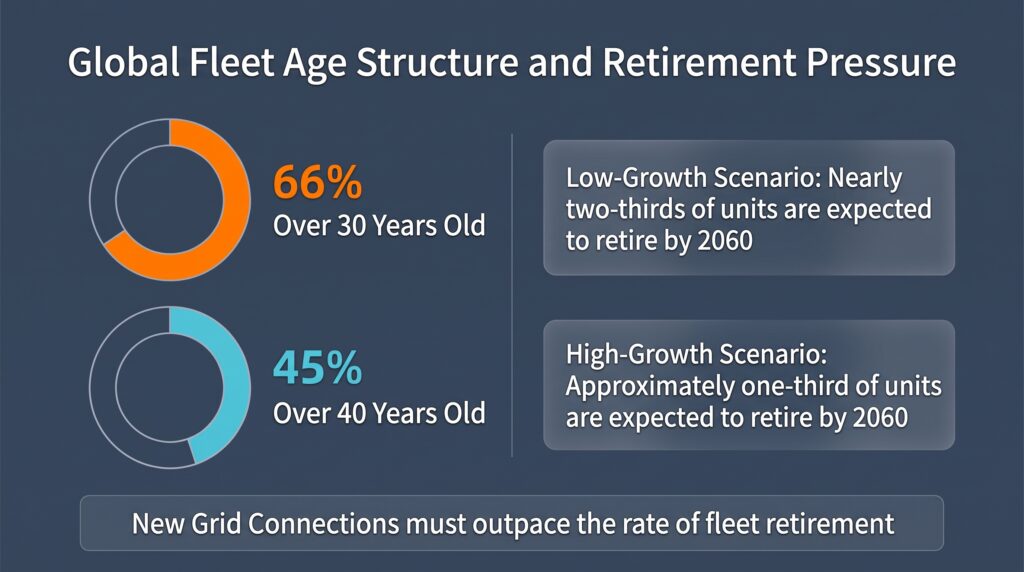
Beyond meeting rising demand, new capacity will also need to offset a substantial wave of upcoming retirements.
The report notes that, as of the end of 2025, 66% of the world's operating nuclear reactors had been in service for more than 30 years, and 45% for more than 40 years. Under the low-case scenario, nearly two-thirds of these units are projected to be retired before 2060; even under the high-case scenario, close to a third would retire. In other words, sustaining net capacity growth depends on new-build and grid-connection rates outpacing the fleet's aging-driven retirements.
In-Depth Analysis
From "Baseload Backup" to a "Multi-Buyer Ecosystem": Nuclear Power's Role Is Being Redefined
The IAEA's sixth consecutive upward revision reflects a structural shift: nuclear power's role is moving from a baseload supplement within large utility grids toward a source of firm power for a diverse set of buyers. This may signal that a new wave of capital and demand is bypassing traditional grid-investment logic and entering the sector directly.
Tech companies have been the most active buyers in this trend. In 2024, Microsoft and Google each signed agreements with nuclear power companies, setting a precedent. The trend has clearly accelerated in 2025–2026: AWS expanded its partnership with Talen Energy into a 17-year power purchase agreement securing 1,920 MW from the Susquehanna nuclear plant; in January 2026, Meta signed three agreements in one go, totaling up to 6.6 GW. Notably, these deals are funded directly by the tech companies themselves, bypassing traditional utility planning — this financing model is emerging as a new pathway alongside conventional nuclear project financing, and echoes the IAEA report's repeated emphasis that "capital commitment is a key condition for realizing the high-growth scenario."
By contrast, shipping decarbonization — also cited by Grossi — remains largely at the conceptual stage. The International Maritime Organization's (IMO) "Net-Zero Framework," originally due for adoption in October 2025, has been repeatedly delayed amid opposition from the United States and other member states; the next key meeting (MEPC 85) is not scheduled until November 23–27, 2026. Nuclear-powered shipping currently lacks a clear, established regulatory mechanism to drive demand, and remains closer to an early-stage technical aspiration than a firm source of new orders — whether it eventually translates into real contracts remains to be seen.
Behind the SMR Surge: Where Standardization and Cost Reduction Are Getting Stuck
The most striking data shift in this year's report is the jump in SMRs' projected share — from 24%/5% last year to 28%/23% this year — with North America assigned as much as 60% of incremental capacity. But from an engineering-economics and industry-status standpoint, this high expectation faces a real test of deployment lag and cost validation.
SMRs' core commercial premise is "factory prefabrication, modular assembly, mass replication" — in theory, avoiding the construction delays and high upfront capital costs common to large Generation III reactors. In practice, however, the only SMRs with genuine commercial operating experience remain concentrated in a handful of demonstration projects in China and Russia: China's Shidao Bay high-temperature gas-cooled reactor demonstration project entered commercial operation in 2023, Russia's floating plant Akademik Lomonosov is already operating, and the BREST-OD-300 fast reactor is under construction. By comparison, most planned commercial SMR projects in the US and Europe remain at the engineering design, safety review, or siting-permit stage, without yet establishing the automated manufacturing and mass-production supply chains needed for genuine economies of scale.
One question worth considering: unit costs for first-of-a-kind commercial reactors tend to run high in the early stages of deployment. If cross-border regulatory regimes fail to achieve mutual recognition, and each reactor design must still undergo years of independent review in every country where it's built, the cost advantage that "standardized mass replication" is supposed to deliver could be substantially eroded by longer deployment timelines. This is precisely why the IAEA itself lists cross-border regulatory cooperation as one of the preconditions for reaching the high-growth scenario — not as a problem already solved.
A "Replacement Rate" Perspective: A More Hidden Line of Defense Beyond the Capacity Ceiling
In assessing the 1,284 GW headline ceiling, it's equally important to account for the "natural depreciation rate" of the existing fleet.
Two-thirds of currently operating reactors have been in service for more than 30 years — a direct legacy of the global nuclear "construction boom" of the 1970s and 80s, now collectively entering the late stages of their operating lives. This means that, over the coming decades, the global nuclear industry must not only pursue net capacity growth, but also fight a large-scale "replacement battle" for its existing fleet.
Reaching the high-growth scenario will require widespread life-extension of operating reactors — and this is already happening, not merely theoretical: several US reactors (e.g., Turkey Point, Surry) have been approved to operate for up to 80 years, an action the NRC is actively implementing. Most European countries are also extending reactor lifetimes from 40 years to somewhere between 50 and 70 years (for example, the Czech Republic's Dukovany plant began preparations in 2026 for an 80-year life-extension application) — but Europe's overall pace remains more cautious than that of the US. If life-extension approvals stall, or rising maintenance costs on aging equipment force earlier-than-planned retirements, new-build capacity would be left playing a "gap-filling" role for a prolonged period, unable to translate into net capacity growth — making it harder to reverse nuclear power's roughly 8% share of global electricity generation.
Viewed against actual 2025 construction data, this structural pressure becomes clearer:
- Retirements (fleet attrition): 7 reactors were permanently shut down globally in 2025 (a combined 2.8 GW, less than 1% of total operating capacity) — indicating that the retirement pace remains moderate for now, with the industry still in a relatively calm period before retirement pressure accelerates.
- Grid connections (near-term output): Only 3 reactors were newly connected to the grid in 2025 (a combined 3.0 GW, barely offsetting retired capacity) — which helps explain why, in a year of surging electricity demand, nuclear generation growth (1.1%) lagged overall electricity demand growth (2.7%), causing nuclear's share of generation to edge slightly lower.
- New construction starts (longer-term pipeline): Global construction starts reached 12 reactors in 2025 (14.3 GW — nearly 5 times the retired capacity). Construction starts are clearly outpacing grid connections, suggesting the supply chain is positioning ahead of need — it just hasn't yet shown up in generation figures.
So the real test of whether nuclear power moves from "rising expectations" to "actual expansion" lies in the next three to five years: whether reactors under construction connect to the grid on schedule, whether leading SMR designs successfully clear regulatory review and enter operation, and whether countries put in place market compensation mechanisms that support the long-term, safe operation of nuclear plants. These factors will say far more about whether nuclear power is "steadily delivering" or merely "optimistic on paper" than the headline capacity ceiling ever could.
Sources
- IAEA 70th General Conference core data:
- World Nuclear News: https://world-nuclear-news.org/articles/iaeas-projections-suggest-there-could-be-1000-smrs-by-2060
- Engineering News: https://engineeringnews.co.za/article/iaea-forecasts-significant-growth-in-global-nuclear-power-generation-in-coming-decades-2026-09-15
- Interesting Engineering: https://interestingengineering.com/energy/1000-small-nuclear-reactors-2060-iaea
- IAEA 2025 fleet status data: https://gov.uz/en/cirns/news/view/220116
- American Nuclear Society (ANS): https://www.ans.org/news/2026-09-14/article-8388/iaea-general-conference-kicks-off-with-opening-remarks-from-dg-grossi/
- Tech company nuclear power agreements:
- TerraPower/Meta official press release: https://www.prnewswire.com/news-releases/terrapower-and-meta-enter-agreement-for-8-sodium-advanced-nuclear-plants-302657043.html
- Vistra/Meta official press release: https://www.prnewswire.com/news-releases/vistra-and-meta-announce-agreements-to-support-nuclear-plants-in-pjm-and-add-new-nuclear-generation-to-the-grid-302656941.html
- Oklo/Meta official press release: https://oklo.com/newsroom/news-details/2026/Oklo-Meta-Announce-Agreement-in-Support-of-1-2-GW-Nuclear-Energy-Development-in-Southern-Ohio/default.aspx
- Talen Energy official press release: https://ir.talenenergy.com/node/8676/html
- ANS official coverage: https://www.ans.org/news/article-6402/constellation-announces-tmi1-restart-power-purchase-agreement-with-microsoft/
- Kairos Power official press release: https://www.kairospower.com/updates/google-signs-new-nuclear-clean-energy-agreement-with-kairos-power
- IMO Net-Zero Framework latest developments: https://maritime-executive.com/index.php/article/imo-concludes-next-round-of-net-zero-discussions-still-divided
- The Moscow Times: https://www.themoscowtimes.com/2026/08/06/worlds-first-floating-nuclear-plant-goes-online-in-russia-rosatom
- NEI Magazine: https://www.neimagazine.com/?p=105414
- US Nuclear Regulatory Commission (NRC) official press release No. 24-072: https://tmia.com/sites/tmia.com/files/media/24-072.pdf
- European reactor life-extension pathways:
This article draws on reporting first published on the Association's WeChat account. If you'd like to see our news updates as soon as they're published, follow our WeChat account 【AFE法中能源】. Our website will continue to provide more complete background and in-depth analysis.
Recent Comments